Ford EcoSport years to avoid? Check the engine first
The 1.0 L engine’s oil-pump recall is the main check on a used EcoSport. Complaint totals cannot fairly rank model years, and newer examples have recalls of their own.
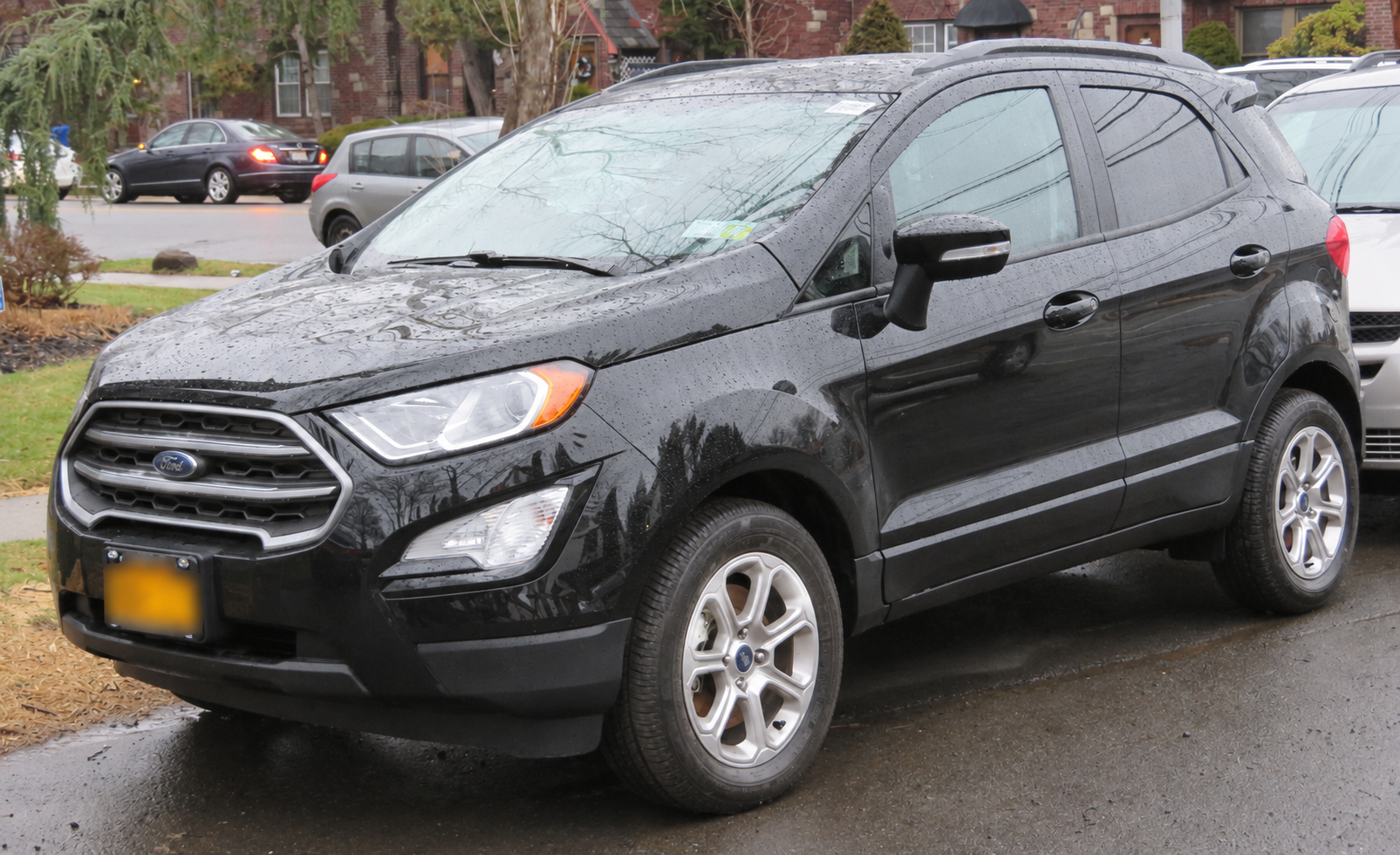

The short answer
MotorAlmanac counts 1,878 owner complaints for U.S.-market Ford EcoSport model years 2018–2022, but none of those years has enough early reports to support a worst-year ranking. Ford's oil-pump recall gives buyers a more concrete concern: affected 1.0L engines can lose oil pressure and seize, with power brake assist lost as well.
The clearest reason to pause on a purchase is an affected 1.0L vehicle without documented completion of recall 23S64. A seller's statement that the engine was replaced needs to be checked against the repair record.
A 2.0L EcoSport falls outside that recall's specified engine configuration. That establishes a difference in recall coverage; it does not establish a better overall failure rate. Later model years also have separate recalls worth checking.
Which EcoSport years does the complaint record flag?
MotorAlmanac's November 24, 2026 snapshot matches these totals in NHTSA's complaint database:
- 2018 Ford EcoSport: 730 complaints overall; 25 filed by the end of 2020.
- 2019 Ford EcoSport: 465 overall; 13 by the end of 2021.
- 2020 Ford EcoSport: 406 overall; 12 by the end of 2022.
- 2021 Ford EcoSport: 265 overall; 27 by the end of 2023.
- 2022 Ford EcoSport: 12 overall; six by the end of 2024.
The window includes the model year and the next two calendar years. MotorAlmanac requires at least 50 complaints in a completed window before comparing a year, with at least three eligible years in the generation. None of these EcoSport years clears the first requirement. Calling 2018 the worst because it has the largest lifetime total would give older vehicles more time to accumulate reports.
Owner complaints are unverified accounts. These counts are not divided by sales or adjusted for mileage, and a component label can cover several different problems.
There is a useful finding in when reports arrived. MotorAlmanac counted 1,624 complaints naming Engine or Engine and Engine Cooling, counting each complaint once. Only 35 were filed in the comparison windows. The remaining 1,589, or 97.8%, were filed afterward.
Together, the records show a problem a year-only ranking would miss: none of the five years clears the complaint threshold, yet Ford's original recall includes 113,689 EcoSports with the 1.0L configuration. The useful buying distinction is the affected engine and its final repair status. The engine-coded total is broader than either belt fault, and filing dates do not necessarily show when failures occurred.
Why does the 1.0L engine need closer scrutiny?
Ford filed recall 23V905, its campaign 23S64, on December 22, 2023. Its Part 573 report lists 113,689 EcoSports within a 139,730-vehicle EcoSport and Focus campaign. The specified EcoSport configuration is a 1.0L engine paired with the 6F15 automatic transmission.
Ford says the oil-pump belt tensioner arm can fracture or separate, and the belt can degrade or lose teeth. Without oil pressure, the engine can suffer damage or seize. Ford also identifies loss of the mechanical vacuum pump needed for power brake assist as part of the safety risk.
This was supported by more than complaint labels. Ford's report describes teardown analysis of 21 returned engines and records 2,099 warranty claims received between June 2016 and October 2023. It does not give an EcoSport-only, model-year breakdown of those claims, so they cannot rank individual EcoSport years.
Ford's June 22, 2026 dealer instructions list EcoSport production at Chennai from April 3, 2017, through December 24, 2021. They use a broader 2017–2022 EcoSport year label and a 147,170-vehicle U.S. population across EcoSport, Focus and Fiesta. The earlier federal report lists 2018–2022 EcoSports and an October 12, 2021 build cutoff. These scope differences make dealer confirmation of the VIN particularly important.
EPA records help distinguish the configurations. EPA lists the 2018 1.0L front-wheel-drive EcoSport at 28 mpg combined and the 2018 2.0L all-wheel-drive version at 25 mpg. Those ratings describe fuel economy, not durability. Confirm the engine and drivetrain on the particular vehicle being offered.
Does an engine replacement mean the recall is complete?
The date and type of repair matter. Ford previously allowed engine replacement as an interim repair while final recall parts were being prepared. Its August 2025 owner letter says parts are available for belt and tensioner replacement and tells owners to confirm availability when making an appointment.
Ford's June 2026 instructions also allow a long-block engine replacement as a final repair after a recall-related failure. An engine replacement therefore needs to be identified as the applicable interim or final repair; its presence on a receipt alone does not answer the question.
For a buyer, the useful records are the dealer's VIN-specific recall status and the work order showing what was installed. Ford's owner letter says an earlier paid repair does not remove the need to complete the recall using the correct parts. It describes the belt-and-tensioner job as taking more than one day, with additional time possible for cooling and scheduling.
Ford has not issued stop-driving instructions under 23S64. Its letter asks owners to arrange the free repair promptly. Recall assistance is available at 1-866-436-7332.
What about the separate timing belt issue?
The engine timing belt and the oil-pump drive belt are separate components. NHTSA closed oil-pump investigation PE23015 on February 14, 2024, in view of recall 23V905. That closure does not settle every belt-related question about this engine.
NHTSA's EA26004 opening document, dated July 31, 2026, describes timing-belt material degrading and debris obstructing the oil-pump pickup screen. It lists 2018–2021 1.0L automatic EcoSports among the products discussed and explains that they were analyzed as peer vehicles during the preceding Fiesta and Focus investigation. EA26004 remained open when this guide was checked. An investigation is not a new recall or proof that every listed vehicle has a defect.
Ford's Customer Satisfaction Program 26L02, dated August 25, 2026, changes the timing-belt and oil-pump-belt maintenance recommendation for affected vehicles to 100,000 miles or six years, whichever comes first. Its EcoSport entries cover certain 2018–2021 vehicles, identified by VIN.
Ford administers 26L02 as a customer-satisfaction program covering the maintenance change and conditional reimbursement for qualifying earlier engine repairs. It requires evidence of maintenance for reimbursement.
The practical conclusion from these documents is that recall completion and belt maintenance answer different questions. Have the dealer confirm both the final 23S64 repair status and the revised maintenance requirements for that VIN. Check elapsed time as well as mileage; an old maintenance booklet alone may not reflect Ford's current interval.
What changes for 2021 and 2022?
The small 2022 complaint total does not clear the model year of specific defects. Ford's Part 573 report for 25V126, campaign 25S12, filed February 28, 2025, covers 18,648 EcoSports from model years 2021–2022. Ford specifies vehicles with the 6F15 automatic transmission, built April 1, 2021, through July 20, 2022.
Ford says a front halfshaft may not have been fully inserted into the transmission. It can disconnect or its splines can wear out, allowing loss of drive power. Ford also identifies possible movement in Park when the parking brake is not applied. The report lists no advance warning.
The free repair checks that the halfshafts are inserted and retained, replacing a shaft when necessary. Ford's remedy owner letter says parts are available. Completion of an engine recall does not establish completion of this separate axle recall.
There is another check for certain 2020–2021 vehicles. Ford's 25V442 report, campaign 25S72, includes EcoSports with the affected SYNC software. The rear-camera image can go blank or remain displayed after reversing ends. The remedy updates the software. This is a software-specific campaign, so model year alone does not establish inclusion.
What to check before you buy
Use the NHTSA recall lookup for the specific VIN, then have Ford confirm campaign eligibility and completion records. For an affected 1.0L vehicle, establish which final 23S64 repair was performed. For a vehicle covered by 26L02, establish the applicable belt interval and replacement history. Check 25S12 and 25S72 separately where applicable.
Ford's letters direct owners to their dealer with the VIN. They also describe reimbursement for qualifying previously paid repairs, subject to documentation and eligibility rules. A reimbursement request does not itself close a recall.
For a used-car shortlist, an unresolved 1.0L recall or unclear repair history is the reason to pause. The records do not support rejecting every EcoSport of one model year or treating a lightly reported year as cleared of the problems documented here.
What this page cannot tell you
These records cannot predict the failure likelihood of an individual EcoSport. Ford's oil-pump report estimates a 100% defect share within its campaign population; that is not a prediction of when or whether each vehicle will stall. Complaint totals are unverified and unadjusted for sales, mileage and reporting behavior.
Engine component counts include faults beyond the recalled oil-pump system. Different engines are not separated consistently in complaint coding, so these data cannot establish that the 2.0L has a lower overall failure rate. Ford's federal filing and later dealer bulletin also use different campaign populations and build windows, which this guide cannot fully reconcile.
An open investigation cannot establish a defect in a particular vehicle. A clean VIN result cannot describe every possible mechanical condition or predict the car's remaining service life.
The vehicles this covers
Ford EcoSport 2018 2019 2020 2021 2022
Sources
This piece reads recall, complaints, investigation, epa, Ford Part 573 safety recall report 23V905 / 23S64, Ford dealer notice 23S64 Supplement 4 June 22 2026, Ford owner notification letter 23S64 August 2025, NHTSA ODI closing resume PE23015, NHTSA ODI opening resume EA26004, Ford Customer Satisfaction Program 26L02 August 25 2026, Ford Part 573 safety recall report 25V126 / 25S12, Ford owner notification letter 25S12, Ford Part 573 safety recall report 25V442 / 25S72, EPA/DOE fuel economy record 39623 2018 Ford EcoSport FWD 1.0L, EPA/DOE fuel economy record 39627 2018 Ford EcoSport AWD 2.0L. How every figure on this site is counted is set out on the methodology page. Whether a particular car is affected by a recall depends on its VIN.
More Ford coverage
 Ford Escape years to avoid? What 29,587 owner complaints showGuides | 9 days ago
 Recall letter but no parts yet: what the interim notice means and what to doGuides | 16 days ago
 2026–2027 Ford F-150 tailgate cable recall: 18,412 trucksRecalls | 21 days ago
 2022–2024 Ford Maverick camera recall fix under NHTSA reviewInvestigations | 24 days ago